Grail Quest for the Eternal Art Imagination Pdf

The Holy Grail (French: Saint Graal, Breton: Graal Santel, Welsh: Greal Sanctaidd, Cornish: Gral) is a treasure that serves as an important motif in Arthurian literature. Dissimilar traditions describe the Holy Grail as a cup, dish, or stone with miraculous powers: providing eternal youth, or sustenance in space affluence, frequently in the custody of the Fisher King. By analogy, any elusive object or goal of great significance may be perceived equally a holy grail by those seeking it.[i]
A "grail", wondrous but not explicitly holy, first appears in Perceval, le Conte du Graal, an unfinished romance written by Chrétien de Troyes around 1190. Chrétien's story attracted many continuators, translators and interpreters in the later 12th and early 13th centuries, including Wolfram von Eschenbach, who perceived the Grail as a stone. In the late 12th century, Robert de Boron wrote in Joseph d'Arimathie that the Grail was Jesus'due south vessel from the Terminal Supper, which Joseph of Arimathea used to grab Christ'south claret at the crucifixion. Thereafter, the Holy Grail became interwoven with the fable of the Holy Chalice, the Last Supper cup, a theme continued in works such equally the Lancelot-Grail wheel and consequently Le Morte d'Arthur.[ii]
Etymology [edit]

The word graal , as it is primeval spelled, comes from One-time French graal or greal , cognate with Old Occitan grazal and Onetime Catalan gresal , meaning "a loving cup or bowl of earth, wood, or metal" (or other various types of vessels in different Occitan dialects).[iii] The nigh unremarkably accustomed etymology derives it from Latin gradalis or gradale via an earlier course, cratalis , a derivative of crater or cratus , which was, in turn, borrowed from Greek krater (κρᾱτήρ, a large wine-mixing vessel).[iii] [iv] [5] [vi] [vii] Culling suggestions include a derivative of cratis , a name for a type of woven handbasket that came to refer to a dish,[8] or a derivative of Latin gradus meaning "'by caste', 'past stages', practical to a dish brought to the table in unlike stages or services during a meal".[9]
In the 15th century, English writer John Hardyng invented a fanciful new etymology for Old French san-graal (or san-gréal ), pregnant "Holy Grail", by parsing information technology as sang réal , meaning "majestic blood".[10] [eleven] This etymology was used by some later medieval British writers such as Thomas Malory, and became prominent in the conspiracy theory adult in the book The Holy Blood and the Holy Grail, in which sang real refers to the Jesus bloodline.[12]
Medieval literature [edit]

The literature surrounding the Grail can be divided into two groups. The commencement concerns Rex Arthur's knights visiting the Grail castle or questing after the object. The second concerns the Grail'due south history in the time of Joseph of Arimathea.
The 9 works from the first group are:
- Perceval, the Story of the Grail by Chrétien de Troyes.
- The Four Continuations of Chrétien's unfinished poem, by authors of differing vision and talent, designed to bring the story to a close.
- Parzival by Wolfram von Eschenbach, which adapted at least the holiness of Robert'south Grail into the framework of Chrétien's story. In Wolfram's telling, the Grail was kept prophylactic at the castle of Munsalvaesche (mons salvationis), entrusted to Titurel, the first Grail King. Some, not to the lowest degree the Benedictine monks, have identified the castle with their real sanctuary of Montserrat in Catalonia.
- The Didot Perceval, named afterward the manuscript's sometime owner, and purportedly a prosification of Robert de Boron'southward sequel to Joseph d'Arimathie and Merlin.
- Welsh romance Peredur son of Efrawg, a loose translation of Chrétien'southward poem and the Continuations, with some influence from native Welsh literature.
- Perlesvaus, chosen the "least approved" Grail romance because of its very different graphic symbol.
- German poem Diu Crône (The Crown), in which Gawain, rather than Perceval, achieves the Grail.
- The Lancelot section of the vast Vulgate Wheel introduced the new Grail hero, Galahad. The Queste del Saint Graal, a follow-up part of the wheel, concerns Galahad's eventual achievement of the Grail.
Of the second grouping at that place are:
- Robert de Boron'southward Joseph d'Arimathie.
- The Estoire del Saint Graal, the commencement part of the Vulgate Cycle (only written after Lancelot and the Queste), based on Robert's tale just expanding it greatly with many new details.
- Verses past Rigaut de Barbezieux, a late 12th or early 13th-century[13] Provençal troubador, where mention is made of Perceval, the lance, and the Grail ("Like Perceval when he lived, who stood amazed in contemplation, so that he was quite unable to ask what purpose the lance and grail served" – "Attressi con Persavaus el temps que vivia, que due south'esbait d'esgarder tant qu'anc not saup demandar de que servia la lansa ni-fifty grazaus"[14]).
The Grail was considered a bowl or dish when kickoff described past Chrétien de Troyes. There, it is a processional salver, a tray, used to serve at a feast.[15] Hélinand of Froidmont described a grail as a "broad and deep saucer" (scutella lata et aliquantulum profunda); other authors had their own ideas. Robert de Boron portrayed it equally the vessel of the Final Supper. Peredur son of Efrawg had no Grail as such, presenting the hero instead with a platter containing his kinsman'due south bloody, severed head.[16]
Chrétien de Troyes [edit]
The Grail is start featured in Perceval, le Conte du Graal (The Story of the Grail) past Chrétien de Troyes,[17] who claims he was working from a source book given to him by his patron, Count Philip of Flanders.[18] In this incomplete poem, dated quondam between 1180 and 1191, the object has not yet acquired the implications of holiness information technology would have in afterwards works. While dining in the magical home of the Fisher King, Perceval witnesses a wondrous procession in which youths carry magnificent objects from one sleeping accommodation to another, passing before him at each course of the meal. First comes a young man conveying a bleeding lance, and then two boys carrying candelabras. Finally, a beautiful young daughter emerges bearing an elaborately decorated graal, or "grail".[19]
Chrétien refers to this object non as "The Grail" only as "a grail" (united nations graal), showing the discussion was used, in its earliest literary context, as a common noun. For Chrétien, a grail was a wide, somewhat deep, dish or basin, interesting because it contained non a pike, salmon, or lamprey, as the audience may accept expected for such a container, merely a single Communion wafer which provided sustenance for the Fisher King's bedridden male parent. Perceval, who had been warned confronting talking too much, remains silent through all of this and wakes up the adjacent morn alone. He afterward learns that if he had asked the appropriate questions about what he saw, he would take healed his maimed host, much to his laurels. The story of the Wounded King's mystical fasting is not unique; several saints were said to have lived without nutrient besides communion, for instance Saint Catherine of Genoa. This may imply that Chrétien intended the Communion wafer to be the significant function of the ritual, and the Grail to be a mere prop.[20]
Robert de Boron [edit]
Though Chrétien's account is the earliest and most influential of all Grail texts, it was in the work of Robert de Boron that the Grail truly became the "Holy Grail" and causeless the course most familiar to modern readers in its Christian context.[21] In his verse romance Joseph d'Arimathie, composed between 1191 and 1202, Robert tells the story of Joseph of Arimathea acquiring the beaker of the Last Supper to collect Christ'south blood upon his removal from the cross. Joseph is thrown in prison, where Christ visits him and explains the mysteries of the blessed cup. Upon his release, Joseph gathers his in-laws and other followers and travels to the w. He founds a dynasty of Grail keepers that eventually includes Perceval.
Wolfram von Eschenbach [edit]
In Parzival, Wolfram von Eschenbach, citing the potency of a certain (probably fictional) Kyot the Provençal, claimed the Grail was a Stone, the sanctuary of the neutral angels who took neither side during Match's rebellion. It is called Lapis exillis, which in alchemy is the proper name of the Philosopher's rock.[22]
Lancelot-Grail [edit]
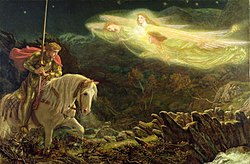
Sir Galahad, the Quest for the Holy Grail past Arthur Hughes (1870)
The authors of the Vulgate Cycle used the Grail as a symbol of divine grace; the virgin Galahad, illegitimate son of Lancelot and Elaine, the globe's greatest knight and the Grail Bearer at the castle of Corbenic, is destined to attain the Grail, his spiritual purity making him a greater warrior than even his illustrious father.[23] The Queste del Saint Graal (The Quest of The Holy Grail) tells also of the adventures of various Knights of the Round Table in their eponymous quest. Some of them, including Percival and Bors the Younger, eventually join Galahad as his companions near the successful end of the Grail Quest and are witnesses of his rising to Heaven.
Galahad and the interpretation of the Grail involving him were picked upwards in the 15th century by Thomas Malory in Le Morte d'Arthur and remain pop today.[24] While it is not explicit that the Holy Grail is never to be seen once again on Globe, it is stated by Malory that at that place has since then been no knight capable of obtaining it.
Scholarly hypotheses [edit]
Scholars have long speculated on the origins of the Holy Grail before Chrétien, suggesting that information technology may contain elements of the trope of magical cauldrons from Celtic mythology and later Welsh mythology combined with Christian legend surrounding the Eucharist,[25] the latter found in Eastern Christian sources, conceivably in that of the Byzantine Mass, or even Persian sources.[26] The view that the "origin" of the Grail legend should be seen as deriving from Celtic mythology was championed by Roger Sherman Loomis, Alfred Nutt and Jessie Weston. Loomis traced a number of parallels between Medieval Welsh literature and Irish material and the Grail romances, including similarities between the Mabinogion 'south Bran the Blessed and the Arthurian Fisher King, and between Bran's life-restoring cauldron and the Grail.
The opposing view dismissed the "Celtic" connections as spurious and interpreted the legend every bit essentially Christian in origin. Joseph Goering has identified sources for Grail imagery in 12th-century wall paintings from churches in the Catalan Pyrenees (now by and large removed to the Museu Nacional d'Fine art de Catalunya), which present unique iconic images of the Virgin Mary belongings a bowl that radiates tongues of fire, images that predate the start literary account past Chrétien de Troyes. Goering argues that they were the original inspiration for the Grail fable.[27] [28]
Psychologists Emma Jung and Marie-Louise von Franz used analytical psychology to interpret the Grail every bit a serial of symbols in their book The Grail Legend.[29] This expanded on interpretations past Carl Jung, which were later invoked by Joseph Campbell.[29]
Richard Barber (2004) argued that the Grail legend is connected to the introduction of "more ceremony and mysticism" surrounding the sacrament of the Eucharist in the loftier medieval menstruum, proposing that the commencement Grail stories may take been connected to the "renewal in this traditional sacrament".[thirty] Daniel Scavone (1999, 2003) has argued that the "Grail" in origin referred to the Prototype of Edessa.[31] Goulven Peron (2016) suggested that the Holy Grail may reflect the horn of the river-god Achelous as described by Ovid in the Metamorphoses.[32]
Later traditions [edit]
Relics [edit]

In the wake of the Arthurian romances, several artifacts came to be identified as the Holy Grail in medieval relic veneration. These artifacts are said to have been the vessel used at the Last Supper, but other details vary. Despite the prominence of the Grail literature, traditions about a Last Supper relic remained rare in contrast to other items associated with Jesus' last days, such as the True Cross and Holy Lance.[33]
One tradition predates the Grail romances: in the seventh century, the pilgrim Arculf reported that the Last Supper chalice was displayed near Jerusalem.[33] [34] In the wake of Robert de Boron's Grail works, several other items came to be claimed as the truthful Terminal Supper vessel. In the late 12th century, one was said to be in Byzantium; Albrecht von Scharfenberg's Grail romance Der Jüngere Titurel associated it explicitly with the Arthurian Grail, but claimed information technology was merely a copy.[eight] This item was said to have been looted in the Fourth Crusade and brought to Troyes in French republic, simply information technology was lost during the French Revolution.[35] [36]
Ii relics associated with the Grail survive today. The Sacro Catino (Sacred Basin, also known equally the Genoa Chalice) is a greenish drinking glass dish held at the Genoa Cathedral said to have been used at the Concluding Supper. Its provenance is unknown, and there are two divergent accounts of how information technology was brought to Genoa by Crusaders in the 12th century. Information technology was not associated with the Last Supper until later, in the wake of the Grail romances; the first known association is in Jacobus de Voragine's relate of Genoa in the late 13th century, which draws on the Grail literary tradition. The Catino was moved and broken during Napoleon's conquest in the early 19th century, revealing that information technology is drinking glass rather than emerald.[8] [37]
The Holy Chalice of Valencia is an agate dish with a mounting for use as a chalice. The bowl may date to Greco-Roman times, merely its dating is unclear, and its provenance is unknown before 1399, when information technology was gifted to Martin I of Aragon. By the 14th century an elaborate tradition had developed that this object was the Last Supper chalice. This tradition mirrors aspects of the Grail fabric, with several major differences, suggesting a separate tradition entirely. Information technology is not associated with Joseph of Arimathea or Jesus' blood; it is said to take been taken to Rome by Saint Peter and afterward entrusted to Saint Lawrence.[38] [39] Early references do not call the object the "Grail"; the first evidence connecting it to the Grail tradition is from the 15th century.[40] The monarchy sold the loving cup in the 15th century to Valencia Cathedral, where it remains a meaning local icon.[41]
Several objects were identified with the Holy Grail in the 17th century.[35] In the 20th century, a series of new items became associated with it. These include the Nanteos Cup, a medieval wooden bowl found near Rhydyfelin, Wales; a glass dish found near Glastonbury, England; and the Antioch chalice, a 6th-century silver-aureate object that became attached to the Grail legend in the 1930s.[42]
Locations associated with the Holy Grail [edit]

Die Gralsburg (The Grail Castle) by Hans Thoma (1899)
In the modernistic era, a number of places have become associated with the Holy Grail. One of the about prominent is Glastonbury in Somerset, England. Glastonbury was associated with King Arthur and his resting place of Avalon past the 12th century.[43] In the 13th century, a legend arose that Joseph of Arimathea was the founder of Glastonbury Abbey. Early on accounts of Joseph at Glastonbury focus on his part every bit the evangelist of U.k. rather than as the custodian of the Holy Grail, but from the 15th century, the Grail became a more prominent role of the legends surrounding Glastonbury.[44] Interest in Glastonbury resurged in the tardily 19th century, inspired by renewed interest in the Arthurian legend and contemporary spiritual movements centered on aboriginal sacred sites.[45] In the belatedly 19th century, John Goodchild hid a glass bowl near Glastonbury; a grouping of his friends, including Wellesley Tudor Pole, retrieved the cup in 1906 and promoted it every bit the original Holy Grail.[46] Glastonbury and its Holy Grail legend accept since become a point of focus for diverse New Age and Neopagan groups.[47]
In the early 20th century, esoteric writers identified Montségur, a stronghold of the heretical Cathar sect in the 13th century, as the Grail castle. Similarly, the 14th-century Rosslyn Chapel in Midlothian, Scotland, became attached to the Grail legend in the mid-20th century when a succession of conspiracy books identified it as a secret hiding place of the Grail.[48]
Modern interpretations [edit]
Pseudohistory and conspiracy theories [edit]
Since the 19th century, the Holy Grail has been linked to diverse conspiracy theories. In 1818, Austrian pseudohistorical author Joseph von Hammer-Purgstall connected the Grail to contemporary myths surrounding the Knights Templar that bandage the lodge as a secret order dedicated to mystical knowledge and relics. In Hammer-Purgstall's work, the Grail is not a concrete relic but a symbol of the secret cognition that the Templars sought. There is no historical bear witness linking the Templars to a search for the Grail, only subsequent writers have elaborated on the Templar theories.[49]
Starting in the early 20th century, writers, particularly in France, further connected the Templars and Grail to the Cathars. In 1906, French esoteric writer Joséphin Péladan identified the Cathar castle of Montségur with Munsalväsche or Montsalvat, the Grail castle in Wolfram'southward Parzival. This identification has inspired a wider legend asserting that the Cathars possessed the Holy Grail.[l] Co-ordinate to these stories, the Cathars guarded the Grail at Montségur, and smuggled it out when the castle cruel in 1244.[51]

The Grail in 1933 German stamp
Beginning in 1933, German writer Otto Rahn published a series of books tying the Grail, Templars, and Cathars to modern German language nationalist mythology. Co-ordinate to Rahn, the Grail was a symbol of a pure Germanic religion repressed by Christianity. Rahn'southward books inspired interest in the Grail in Nazi occultism and led to Heinrich Himmler's abortive sponsorship of Rahn's search for the Grail, too as many subsequent conspiracy theories and fictional works about the Nazis searching for the Grail.[52]
In the tardily 20th century, writers Michael Baigent, Richard Leigh and Henry Lincoln created one of the well-nigh widely known conspiracy theories about the Holy Grail. The theory kickoff appeared in the BBC documentary series Chronicle in the 1970s, and was elaborated upon in the bestselling 1982 book Holy Claret, Holy Grail.[12] The theory combines myths about the Templars and Cathars with various other legends and a prominent hoax about a underground order chosen the Priory of Sion. Co-ordinate to this theory, the Holy Grail is non a physical object, but a symbol of the bloodline of Jesus. The blood connection is based on the etymological reading of san greal (holy grail) equally sang existent (regal blood), which dates to the 15th century.[12] The narrative developed here is that Jesus was not divine, and had children with Mary Magdalene, who took the family unit to France where their descendants became the Merovingians dynasty. While the Catholic Church worked to destroy the dynasty, they were protected by the Priory of Sion and their assembly, including the Templars, Cathars, and other secret societies.[53] The volume, its arguments, and its evidence have been widely dismissed by scholars as pseudohistorical, just it has had a vast influence on conspiracy and alternating history books. It has also inspired fiction, most notably Dan Brown'southward 2003 novel The Da Vinci Code and its 2006 film adaptation.[54]
Music and painting [edit]

The combination of hushed reverence, chromatic harmonies and sexualized imagery in Richard Wagner's terminal music drama Parsifal, premiered in 1882, adult this theme, associating the grail – now periodically producing blood – straight with female fertility.[55] The high seriousness of the subject area was also epitomized in Dante Gabriel Rossetti's painting in which a adult female modeled by Alexa Wilding holds the Grail with one mitt, while adopting a gesture of blessing with the other.[56]
A major mural series depicting the Quest for the Holy Grail was done past the artist Edwin Austin Abbey during the first decade of the 20th century for the Boston Public Library. Other artists, including George Frederic Watts[57] and William Dyce, also portrayed grail subjects.[58]
Literature [edit]
The story of the Grail and of the quest to find information technology became increasingly popular in the 19th century, referred to in literature such as Alfred, Lord Tennyson's Arthurian cycle Idylls of the King. A sexualised interpretation of the grail, now identified with female genitalia, appeared in 1870 in Hargrave Jennings' book The Rosicrucians, Their Rites and Mysteries.[59]
- T. S. Eliot's poem The Waste material Land (1922) loosely follows the legend of the Holy Grail and the Fisher Rex combined with vignettes of contemporary British gild. In his starting time note to the poem Eliot attributes the title to Jessie Weston'southward book on the Grail legend, From Ritual to Romance. The allusion is to the wounding of the Fisher Rex and the subsequent sterility of his lands. A poem of the same title, though otherwise dissimilar, written by Madison Cawein, was published in 1913 in Verse.[60]
- In John Cowper Powys'south A Glastonbury Romance (1932) the "heroine is the Grail,"[61] and its central concern is with the diverse myths and legends along with history associated with Glastonbury. It is as well possible to see most of the chief characters as undertaking a Grail quest.[62]
- The Grail is central in Charles Williams' novel War in Heaven (1930) and his two collections of poems about Taliessin, Taliessin Through Logres and Region of the Summer Stars (1938).
- The Silver Chalice (1952) is a not-Arthurian historical Grail novel by Thomas B. Costain.
- A quest for the Grail appears in Nelson DeMille's adventure novel The Quest (1975), set during the 1970s.
- Marion Zimmer Bradley's Arthurian revisionist fantasy novel The Mists of Avalon (1983) presented the Grail as a symbol of water, part of a set of objects representing the four classical elements.
- The master theme of Rosalind Miles' Child of the Holy Grail (2000) in her Guenevere series is the story of the Grail quest by the 14-year-old Galahad.
- The Grail motif features heavily in Umberto Eco's 2000 novel Baudolino, set up in the twelfth century.
- It is the subject area of Bernard Cornwell's historical fiction series of books The Grail Quest (2000–2012), gear up during the Hundred Years War. In his series the Warlord Chronicles, an adaptation of the Arthurian legend, Cornwell also reimagines the Grail quest as a quest for a cauldron which is one of the 13 Treasures of Britain from Celtic mythology.
- Influenced by the 1982 publication of the ostensibly non-fiction The Holy Blood and the Holy Grail, Dan Brown's The Da Vinci Code (2003) has the "grail" taken to refer to Mary Magdalene as the "receptacle" of Jesus' bloodline (playing on the sang existent etymology). In Brown's novel, it is hinted that this Grail was long cached below Rosslyn Chapel in Scotland, just that in recent decades its guardians had it moved to a secret chamber embedded in the floor beneath the Inverted Pyramid in the entrance of the Louvre museum.
- Michael Moorcock's fantasy novel The War Hound and the World'southward Pain (1981) depicts a supernatural Grail quest set in the era of the Xxx Years' War.
- German history and fantasy novel writer Rainer One thousand. Schröder wrote the trilogy Die Bruderschaft vom Heiligen Gral (The Brotherhood of the Holy Grail) virtually a group of 4 Knights Templar who salve the Grail from the Fall of Acco 1291 and go through an Odyssey to bring it to the Temple in Paris in the kickoff two books, Der Fall von Akkon (2006) and Das Amulett der Wüstenkrieger (2006), while defending the holy relic from the attempts of a satanic sect chosen Iscarians to steal information technology. In the third book, Das Labyrinth der schwarzen Abtei (2007), the iv heroes must reunite to smuggle the Holy Grail out of the Temple in Paris subsequently the autumn of the Knights Templar 1307, again pursued by the Iscarians (who in the novel used the Male monarch'southward antagonism against the Templars to their advantage). Interestingly, Schröder likewise indirectly addresses the Cathar Theory by letting the four heroes encounter Cathars – amongst them old friends from their flight from Acco – on their mode to Portugal to seek refuge with the Rex of Portugal and travel further w.
- The 15th novel in The Dresden Files series by Jim Butcher, Skin Game (2014), features Harry Dresden beingness recruited by Denarian and longtime enemy Nicodemus into a heist team seeking to recollect the Holy Grail from the vault of Hades, the lord of the Underworld. The properties of the particular are not explicit, but the relic itself makes an appearance and is in the easily of Nicodemus by the stop of the novel's events.
- The Holy Grail features prominently in Jack Vance's Lyonesse Trilogy, where it is the subject field of an earlier quest, several generations before the birth of King Arthur. Withal, in contrast to the Arthurian catechism. Vance'southward Grail is a common object lacking whatever magical or spiritual qualities, and the characters finding information technology derive footling do good.
- Grails: Quests of the Dawn (1994), edited by Richard Gilliam, Martin H. Greenberg, and Edward Due east. Kramer is a collection of 25 short stories most the grail by various science fiction and fantasy writers.
Film and other media [edit]
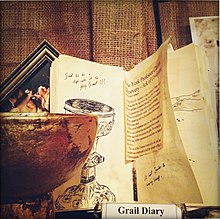
In the movie theatre, the Holy Grail debuted in the 1904 silent moving picture Parsifal, an accommodation of Wagner's opera by Edwin S. Porter. More than recent cinematic adaptations include Costain's The Silver Chalice made into a 1954 motion-picture show by Victor Saville and Brown's The Da Vinci Code turned into a 2006 pic past Ron Howard.
- The silent drama motion picture The Calorie-free in the Dark (1922) involves discovery of the Grail in mod times.
- Robert Bresson's fantasy film Lancelot du Lac (1974) includes a more realistic version of the Grail quest from Arthurian romances.
- Monty Python and the Holy Grail (1975) is a comedic take on the Arthurian Grail quest, adapted in 2004 every bit the phase production Spamalot.
- John Boorman, in his fantasy movie Excalibur (1981), attempted to restore a more traditional heroic representation of an Arthurian tale, in which the Grail is revealed as a mystical means to revitalise Arthur and the arid country to which his depressive sickness is connected.
- Steven Spielberg's take a chance motion picture Indiana Jones and the Final Crusade (1989) features Indiana Jones and his father in a race for the Grail against the Nazis.
- In a pair of fifth-flavor episodes (September 1989), entitled "Legend of the Holy Rose," MacGyver undertakes a quest for the Grail.
- Terry Gilliam'south one-act-drama pic The Fisher King (1991) features the Grail quest in the modern New York Urban center.
- In the flavour one episode "Grail" (1994) of the idiot box series Babylon 5, a man named Aldous Gajic visits Babylon v in his continuing quest to find the Holy Grail. His quest is primarily a plot device, every bit the episode'south action revolves not effectually the quest but rather around his presence and affect on the life of a station resident.
- The video game Gabriel Knight 3: Claret of the Sacred, Blood of the Damned (1999) features an alternate version of the Grail, interwoven with the mythology of the Knights Templar. The Holy Grail is revealed in the story to be the blood of Jesus Christ that contains his power, only attainable to those descended from him, with the vessel of the Grail beingness defined as his torso itself which the Templars uncovered in the Holy Lands.
- In Pretty Guardian Sailor Moon, the Holy Grail (Sehai in the anime, or Rainbow Moon Beaker) is the magical object with which Sailor Moon transforms in her Super grade.
- A scientific discipline fiction version of the Grail Quest is cardinal theme in the Stargate SG-ane season 10 episode "The Quest" (2006).
- The song "Holy Grail" past Jay-Z featuring Justin Timberlake was released in 2013.
- In the video game Persona 5 (2016), the Holy Grail is the Treasure of the game's final Palace, representing the combined desires of all of humanity for a higher power to take command their lives and brand a earth that has no sense of individuality.
- In the telly series Knightfall (2017), the search for the Holy Grail by the Knights Templar is a major theme of the series' first flavor. The Grail, which appears as a uncomplicated earthenware cup, is coveted by diverse factions including the Pope, who thinks that possession of information technology will enable him to ignite another Crusade.
- In the Fate franchise, the Holy Grail serves as the prize of the Holy Grail War, granting a single wish to the victor of the boxing royale. However, it is hinted at throughout the serial that this Grail is non the existent chalice of Christ, just is actually an detail of uncertain nature created by mages some generations ago.
- In the Assassinator'southward Creed video game franchise the Holy Grail is mentioned. In the original game, i Templar refers to the main relic of the game as the Holy Grail, although information technology was later discovered to exist one of many Apples of Eden. The Holy Grail was mentioned again in Templar Legends, either ending up in Scotland or Spain by dissimilar accounts. The Holy Grail appears over again in Assassin's Creed: Altaïr's Chronicles, by the name of the Beaker, however this time not equally an object but as a woman named Adha, like to the sang rael, or royal blood, interpretation.
- In the fourth series of The G Tour, the trio goes to Nosy Boraha where they accidentally find the Holy Grail while searching for La Buse's buried treasure.
- In the 17th episode of Little Witch Academia, "Amanda O'Neill and the Holy Grail", the Holy Grail is used as a plot device in which witches Amanda O'Neill and Akko Kagari set out to find the item itself at Appleton School.
- In the 12th episode of season 9 of the American prove The Office, Jim Halpert sends Dwight Schrute on a wild goose chase to notice the Holy Grail. After Dwight completing all the clues to find it, merely coming up empty handed, the camera cuts to Glenn drinking out of it in his office.[63]
See also [edit]
- Akshaya Patra (Hindu mythology)
- Arma Christi
- Cornucopia (Greek mythology)
- Cup of Jamshid (Persian mythology)
- Fairy cup legend
- Holy Beaker (Christian mythology)
- List of mythological objects
- Relics associated with Jesus
- Sampo (Finnish mythology)
- Salsabil (Quran)
References [edit]
- ^ "Definition of Holy Grail". Merriam-Webster. Retrieved December eighteen, 2017.
- ^ Campbell 1990, p. 210.
- ^ a b Diez, Friedrich. An etymological dictionary of the Romance languages, Williams and Norgate, 1864, p. 236.
- ^ Nitze, William A. Concerning the Word Graal, Greal, Modern Philology, Vol. 13, No. 11 (Mar., 1916), pp. 681–684 .
- ^ Jung, Emma and von Franz, Marie-Louise. The Grail Legend, Princeton University Press, 1998, pp. 116–117.
- ^ Skeat, Walter William. Joseph of Arimathie, Pub. for the Early English Text Society, by North. Trübner & Co., 1871, pp. xxxvi–xxxvii
- ^ Mueller, Eduard. Etymologisches Wörterbuch der englischen Sprache: A–Chiliad , chettler, 1865, p. 461.
- ^ a b c Hairdresser 2004, p. 93.
- ^ Richard O'Gorman, "Grail" in Norris J. Lacy, The Arthurian Encyclopedia, 1986
- ^ Barber 2004, p. 215.
- ^ Wood 2012, p. 55, 77.
- ^ a b c Wood 2012, p. 77.
- ^ Hairdresser 2004, p. 418.
- ^ Sayce, Olive. Exemplary comparison from Homer to Petrarch, DS Brewer, 2008, p. 143.
- ^ Staines, David. (Trans.) The Consummate Romances of Chrétien de Troyes. Indiana University Press, Bloomington & Indianapolis, 1990, page 380.
- ^ Invitee, Lady Charlotte. The Mabinogion. A Facsimile Reproduction of the Complete 1877 Edition, Academy Press Limited Edition 1978, Chicago, Ill. folio 124.
- ^ Loomis 1991.
- ^ According to a French scholar, the book given by Philip I may be Ovid's The Metamorphoses, in POZ #76 Archived 2013-04-20 at the Wayback Machine(in French).
- ^ Staines, David. (Trans.) The Complete Romances of Chrétien de Troyes. Indiana University Press, Bloomington & Indianapolis, 1990, page 379.
- ^ Loomis 1991, p. 184.
- ^ Weston 1993, p.161.
- ^ Von Eschenbach, Wolfram. Parzival. Hatto, A.T. translator. Penguin Books, 1980, folio 239.
- ^ The Quest of The Holy Grail, translated past Matarasso, P.Thou., Penguin Books, 1969, page sixty.
- ^ Malory, Sir Thomas, Le Morte D'Arthur, Penguin Books, 1969, Book II, folio 256.
- ^ Weston 1993, p. 74, 129.
- ^ Jung, Emma and von Franz, Marie-Louise. The Grail Fable, Sigo Press, Boston, 1980, p. 14.
- ^ Goering, Joseph (2005). The Virgin and the Grail: Origins of a Fable. Yale Academy Printing. ISBN 0-300-10661-0. [i]
- ^ Rynor, Micah (October twenty, 2005). "Holy Grail legend may exist tied to paintings". world wide web.news.utoronto.ca.
- ^ a b Barber 2004, p. 248–252.
- ^ Barber 2004.
- ^ D. Scavone: "Joseph of Arimathea, the Holy Grail and the Edessa Icon," Arthuriana vol. 9, no. 4, 3-31 (Winter 1999) (Article and abstruse); Scavone, "British King Lucius, the Grail and Joseph of Arimathea: The Question of Byzantine Origins.", Publications of the Medieval Clan of the Midwest 10 (2003): 101-42, vol. x, 101-142 (2003).
- ^ Peron, Goulven. 50'influence des Metamorphoses d'Ovide sur la visite de Perceval au chateau du Roi Pecheur, Journal of the International Arthurian Society, Vol. 4, Event 1, 2016, p. 113-134.
- ^ a b Wood 2012, p. 91.
- ^ Barber 2004, p. 167.
- ^ a b Wood 2012, p. 94.
- ^ Barber 2004, p. 168.
- ^ Woods 2012, p. 94–95.
- ^ Wood 2012, p. 95–96.
- ^ Barber 2004, p. 169–170.
- ^ Barber 2004, p. 170.
- ^ Wood 2012, p. 95.
- ^ Forest 2012, p. 96–97.
- ^ Forest 2012, p. 51–52.
- ^ Forest 2012, p. 53–55.
- ^ Wood 2012, p. 55–60.
- ^ Wood 2012, p. 57–58.
- ^ Wood 2012, p. 58–60.
- ^ Wood 2012, pp. 75–76, 88–89.
- ^ Wood 2012, p. 70, 73–74.
- ^ Wood 2012, p. 75–76.
- ^ Wood 2012, p. 74–76.
- ^ Forest 2012, p. 76–77.
- ^ Wood 2012, p. 77–82.
- ^ Forest 2012, p. 77, 81–82.
- ^ Donington, Robert (1963). Wagner's "Ring" and its Symbols: the Music and the Myth. Faber
- ^ "Rossetti, Dante Gabriel, 1828–1882, Tate".
- ^ "George Frederick Watts, 1860-62, Sir Galahad, oil on canvas, 191.viii x 107 cm, Harvard Art Museums, Fogg Museum".
- ^ Shichtman, Martin B.; Carley, James P., (eds.) Civilization and the King: The Social Implications of the Arthurian Legend, SUNY Press, Albany, N.Y., 1994, p. 264.
- ^ Writing of the Order of the Garter ceremonies Jennings writes on page 323:- The whole refers to King Arthur and his Knights of the Round Table; gear up round as sentinels ('in lodge') of the Sangreal, or Holy Graal--the 'Cede Mysterious', or 'Eucharist'. Merely how is all this magic and sacred in the estimate of the Rosicrucians?' an inquirer will very naturally ask. The respond to all this is very, aplenty and satisfactory; but particulars must be left to the sagacity of the querist himself, because propriety does non admit of explanation. Suffice information technology to say, that it is ane of the about curious and wonderful subjects which has occupied the attention of antiquaries. That archaeological puzzle, the 'Round Table of Rex Arthur', is a perfect brandish of this whole subject of the origin of the 'Garter'; it springs directly from it, beingness the same object as that enclosed past the mythic garter, 'garder', or 'girther.'
- ^ "January 1913 : Poetry Magazine". Poetryfoundation.org. Retrieved 21 November 2012.
- ^ "Preface" to A Glastonbury Romance. London: Macdonald, 1955, p. xiii.
- ^ Krissdottir, Morine. Descent of Retentiveness: The Life of John Cowper Powys. London: Overlook Press, 2007, pp. 252-3.
- ^ Spotter The Role Highlight: The Dunder Code - NBC.com, 2013-01-25, retrieved 2021-12-09
Further reading [edit]
- Barber, Richard (2004). The Holy Grail: Imagination and Belief. Harvard University Press.
- Campbell, Joseph (1990). Transformations of Myth Through Time. Harper & Row Publishers, New York.
- Loomis, Roger Sherman (1991). The Grail: From Celtic Myth to Christian Symbol. Princeton. ISBN 0-691-02075-2
- Weston, Jessie 50. (1993; originally published 1920). From Ritual To Romance. Princeton Academy Press, Princeton, New Jersey.
- Woods, Juliette (2012). The Holy Grail: History and Legend. University of Wales Press. ISBN 9780708325247.
External links [edit]
 | Wikimedia Commons has media related to Holy Grail. |
- Holy Grail on In Our Time at the BBC
- The Holy Grail at the Camelot Project
- The Holy Grail at the Catholic Encyclopedia
- The Holy Grail today in Valencia Cathedral
- (in French) XVth-century Erstwhile French Estoire del saint Graal manuscript BNF fr. 113 Bibliothèque Nationale de France, option of illuminated folios, Modernistic French Translation, Commentaries.
-
 The full text of Studies on the fable of the Holy Grail at Wikisource
Source: https://en.wikipedia.org/wiki/Holy_Grail
0 Response to "Grail Quest for the Eternal Art Imagination Pdf"
Post a Comment